
When to Replace Walking Shoes
Once you find a comfortable pair of walking shoes that support your feet, it is hard to part with them. Knowing when to replace your walking shoes can

Also Known As: Incline chest press, incline dumbbell chest press
Targets: Chest, shoulders, triceps
Equipment Needed: Dumbbells and an incline bench
Level: Intermediate
The incline dumbbell press is a free weight exercise designed to target the chest, shoulders, and triceps, independently hitting each side of the body. This exercise is a great way to focus on and define your upper-chest muscles.
Unlike the more traditional flat bench press, the incline press shifts the movement's focus to the upper portion of the pectoral muscle groups and the front of the shoulder. This allows for more significant hypertrophy (muscle growth) of the upper chest when the exercise is performed regularly.
The incline dumbbell press is designed to increase chest strength and size, so it's typically included in a well-rounded, intermediate strength training program. If you split up your weekly workouts by body part, include this chest exercise on your upper body or chest day, after exercises like pushups or the flat bench press.
All you need to perform the incline dumbbell press is an incline bench or adjustable bench, and a set of dumbbells. You won't need much more space beyond the space required for the bench itself.
If your bench is adjustable, set the incline to between 30- to 45-degrees. The bigger the angle, the more the exercise will engage the shoulders.
The best angle for an incline dumbbell press is about 30 degrees. However, this could differ based on your anatomy. As with any exercise, changing the incline is a useful way to switch up your training every few weeks and hit your muscles in new challenging ways.
You'll want to select dumbbells that are lighter than you'd use for a flat dumbbell bench press and when performing a barbell incline press. If you're unsure of the right weight, start light and work your way up until you feel challenged but can still do an entire set using proper form.
The dumbbell incline press targets the upper portion of the chest—specifically, the clavicular head of the pectoralis major—an area of the chest almost completely unengaged during other common chest exercises, like the traditional bench press, incline pushups, and chest fly. The incline press also hits the anterior head of the deltoid muscle of the shoulders or the front part of your shoulder.
When the dumbbell incline press is performed regularly, you'll develop a more well-balanced chest and shoulder musculature, helping to keep the shoulder joint stable and strong.
Functionally, the dumbbell incline press transfers naturally to a range of pushing and pressing motions, such as pushing open a heavy door or putting groceries away on elevated shelves.
The dumbbell version of the incline press is especially beneficial for correcting strength imbalances between each side of your body. It's common for one arm to be stronger than the other. By using dumbbells to perform this exercise, each arm works independently, which prevents the dominant arm from "taking over" to complete the lift, improving strength and stability on both sides of the body.
The incline dumbbell press can be modified in various ways or made more challenging to suit individual needs and fitness goals.
If isolating each shoulder independently doesn't work for you, you can modify the exercise and still get similar results. Instead of the dumbbell incline press, opt for the barbell incline press. The barbell exercise targets the same muscle groups in the same way but doesn't require the unilateral control that the dumbbell press requires.
This exercise will help you develop the baseline strength required for the movement while also starting to engage the stabilizing muscles of the shoulders without isolating each shoulder independently.
Perform the exercise in the exact same way as the dumbbell press, except using a barbell gripped with both arms instead of individual dumbbells. Set the bench at a 30 to 45-degree incline under a rack with the bar loaded. Grip the bar wider than shoulder width.
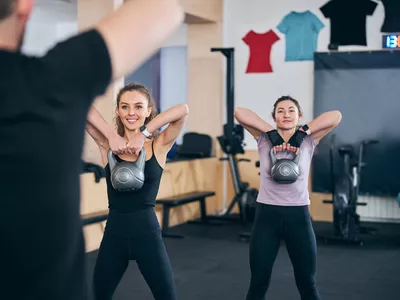
Make the exercise harder by switching out your dumbbells for a set of kettlebells. Due to the uneven weight distribution of kettlebells (the "bell" portion weighs more than the handle of the equipment), it requires more stability and control to perform the exercise correctly.
This exercise is otherwise performed in the same way as the incline dumbbell press, but you're pressing kettlebells with each hand, rather than dumbbells.
You can also substantially engage your core by performing the exercise as a single-arm kettlebell incline press.
This exercise can seem deceptively simple, making it easy to overlook possible mistakes. Read on to learn about potential issues as well as how to avoid them.
If you've been doing dumbbell bench press or incline barbell press for a while, you probably have a good idea of how much weight you can handle for these exercises. However, that doesn't mean you'll be able to lift the same amount when trying the dumbbell incline press.
The incline press, as a whole, uses smaller muscle groups than the flat bench press, so you'll need to decrease your weight a bit for the incline press. Even if you're familiar with the incline barbell press, you may still need to reduce your weight for the dumbbell version of the exercise.
This is because the dumbbell press requires each arm to lift its dumbbell independently, which requires more strength. This action is more challenging to control and ends up using more of the stabilizing muscles of the shoulder. Selecting a lighter weight helps ensure you can complete the exercise safely.
Selecting a weight that's too heavy typically leads to other common mistakes, which can undercut your efforts or result in injury. If you start with the right weight for you, you'll be less likely to encounter the other issues mentioned below.
Cocking your wrists backward while holding the dumbbells—forming a 90-degree angle between the back of your hand and forearm—may not seem like a big issue, but holding the dumbbells this way puts a lot of strain on your wrists. Focus on keeping your wrists straight so that they're perpendicular to the ground throughout the exercise to prevent wrist injury.
Doing a chest press on a flat bench positioned at 0-degrees targets the middle of your pecs. Likewise, doing a press on an upright bench positioned at 90-degrees targets your shoulders. To effectively target the upper portion of your chest, you need to select an angle somewhere between those two angles.
The trick, though, is selecting the right angle to work the muscles you want to strengthen. Generally speaking, you should set your bench between 30- and 45-degrees. The 45-degree angle will hit more of your shoulders, while the 30-degree angle will target the pecs to a greater degree.
Lowering the weights quickly and "bouncing" them up off the top of your chest is ineffective. If you find yourself doing this (or if you are tempted to do so), that's a good indication that you're lifting more weight than you should be.
When you speed through a movement like this, you end up losing the target focus for the exercise, allowing other muscle groups and momentum to help you complete the move. This may not seem like a big deal, but it ends up reducing the effectiveness of your workout, making it harder to see the improvements you want to see.
Instead of overlifting, reduce the weight you are lifting until you can complete the exercise without any bouncing.
When you are fatigued toward the end of a set or if you're trying to lift more weight than you should, you may find yourself straining and over-arching your back to try to force the dumbbells upward. This can open you up to the possibility of a back strain. Also, your efforts will be shortchanged.
You'll end up recruiting muscle groups other than the specific muscles intended to be targeted by the exercise. There is a natural arch in your back that should be there while performing this press exercise. You don't want to eliminate this natural curve. When you try hard to push your back into the bench, your shoulders will naturally roll forward. Try to maintain the natural arch without increasing it.
If you find yourself straining toward the end of a set, ask a friend to spot you as you lift. This will allow you to finish your set without altering the movement. If you find yourself over-arching your back from the get-go, choose a lighter set of dumbbells.
When performing the incline dumbbell press, the most important thing is to select an appropriate weight for your strength level, which is probably less than you think. You should be able to complete between 8 and 12 repetitions with the weight you select for a typical workout routine.
The dumbbell incline press is generally a safe exercise, but it requires a baseline level of strength, and it shouldn't be attempted if you're new to strength training. In that case, start with machine weights or a barbell incline press to grow accustomed to the movement, then move on to the incline dumbbell press once you're ready.
The incline press can be problematic for those who experience shoulder pain. If you have ongoing shoulder pain, attempt the exercise on a machine or with a barbell before trying it with dumbbells. If you experience sharp or shooting pain at any point during the exercise, stop and opt for exercises that don't cause pain.
Incline dumbbell press is not necessarily harder than flat bench press, but it is more difficult to lift as heavy weight. So, while the exercise is no more complex, you will likely need to use less weight to do an incline press than a flat bench press.
You can perform an incline or flat bench press first. Choosing to do a lighter incline press before a heavier flat bench press is one method to try. This way you can use the incline press as an activation exercise. Alternatively, begin with the exercise that targets the area you are especially trying to work on. Incline presses work the upper pectorals more than the flat bench, for instance.
The incline dumbbell press is not necessarily better than the barbell incline press. Dumbbell incline presses can however be performed with a potentially greater range of motion and less weight, which will increase muscle fiber activation with less fatigue. However, the barbell press can be performed with more weight, so may be better for building strength.
Incorporate this move into one of these popular workouts:

Once you find a comfortable pair of walking shoes that support your feet, it is hard to part with them. Knowing when to replace your walking shoes can

One of the most common mistakes you can make when buying walking shoes is prioritizing fashion over function, according to physical therapist Karena W

Choosing the right walking shoes is always important, but the decision is especially crucial for seniors who need extra support, comfort, and accommod

Packing a gym bag is a fairly routine procedure for anyone who goes to the gym regularly. You might even keep your bag pre-packed in your car or near
The upright row is considered one of the best muscle builders for the back and shoulders. However, it is also potentially dangerous for the shoulders

Great workout leggings are a must-have for anyone who likes to exercise. And they’re not quite the same as lounge leggings. While lounge leggings can
We are an information hub dedicated to delivering clear, trustworthy, and engaging content across a wide spectrum of topics — from innovation and trends to daily life, wellness, and global developments.
Our team is passionate about creating content that helps people stay curious, make informed decisions, and understand the world with greater clarity and context.
With a focus on quality, relevance, and accessibility, we aim to offer a meaningful experience for everyone seeking knowledge, ideas, and thoughtful perspectives.