
Motivate Yourself to Walk More With the Walk the Distance App
The free Walk The Distance app is based on the Virtual Walk app and is available for both iOS and Android. It tracks your walking via the acceleromete

Targets: Chest, arms, shoulders, and core
Level: Beginner
Push-ups build both upper-body and core strength. They have many optional modifications; beginners can start with easier versions, while more advanced exercisers can use a challenging variation. You can do the push-up as part of a bodyweight exercise session, a circuit training workout, or a strength workout.
Learning how to properly do a push-up is less complicated than it may seem — read on for our tips, the benefits, and 8 push-up variations.
Verywell / Ben Goldstein
Doing a push-up requires getting on the floor on all fours, positioning your hands slightly wider than your shoulders. Don't lock out the elbows; keep them slightly bent. Extend your legs back so you are balanced on your hands and toes, your feet hip-width apart. Once in this position, here is how you will do a push-up.
Keep a tight core throughout the entire push-up. Also, keep your body in a straight line from head to toe without sagging in the middle or arching your back.
The abdominal muscles used to hold the body rigid during the push-up are the rectus abdominis and the internal and external obliques. As the push-up involves multiple joints, it is a compound exercise.
The upper body muscles that come into play in the push-up are the deltoids of the shoulders, the pectoral muscles of the chest, the triceps and biceps of the upper arm, and the gluteal or hip muscles, and the erector spinae of the back.
In daily life, you often need to push against objects, from doors to shopping carts. The functional fitness you develop with push-ups provides the strength needed to perform these movements. Working the stabilizer muscles around the shoulders can help protect you from rotator cuff injuries.
A 2019 study also found that people who can do 40 push-ups have fewer cardiovascular disease events than those who cannot complete 10 push-ups. Push-ups can be used as a measure of upper body fitness, allowing you to assess whether you need to be doing more to keep your upper body in good working condition.
Push-ups do not burn fat directly, but resistance training does burn calories which can help create a deficit needed for weight loss. As well, building muscle can increase your metabolism. However, you cannot spot reduce fat and push-ups will not burn fat off a particular body part.
Whether you are a beginner and need to make this exercise easier, or you're advanced and want more of a challenge—or want to better target a specific muscle—there is a push-up variation for you.
This is a modified version of the standard push-up performed on the knees rather than on the toes. Be sure to keep the knees, hips, and shoulders all in a straight line. Do not allow yourself to bend at the hips.
You can also do incline push-ups to make this exercise a bit easier. Stand several feet away from the table or bench. Use the same push-up technique as above to lower yourself until the elbows are at 90 degrees, then raise back up. Keep your core engaged throughout the movement.
Verywell / Ben Goldstein
Add core stability work for increased difficulty and effectiveness. Make sure you can do about 20 basic push-ups before trying stability ball push-ups.
Decline push-ups are a more difficult push-up, performed with the feet raised up on a box or bench. You can adjust the box height to increase or decrease the resistance using just your body weight.
Verywell / Ben Goldstein
This is a plyometric exercise in which you push yourself up with enough power so that your hands come off the floor and you clap in midair. This exercise is not for novice exercisers. You can get injured very easily if you haven't worked up to these.
The diamond push-up variation targets the triceps brachii. It is done with your hands close together and the index fingers and thumbs of one hand touching the other hand, making a diamond shape on the floor. You then do push-ups with your hands touching the center of your chest and elbows close to your sides during each rep.
This variation adds alternating dumbbell lat rows to the top of each rep. This modification increases the intensity of the exercise, activates the core stabilizers, and engages the latissimus dorsi (back) muscles.
To do it, perform the push-up with hands holding dumbbells versus pushing against the floor. At the top of the movement, pull the weight up to the chest before lowering it back to the floor.
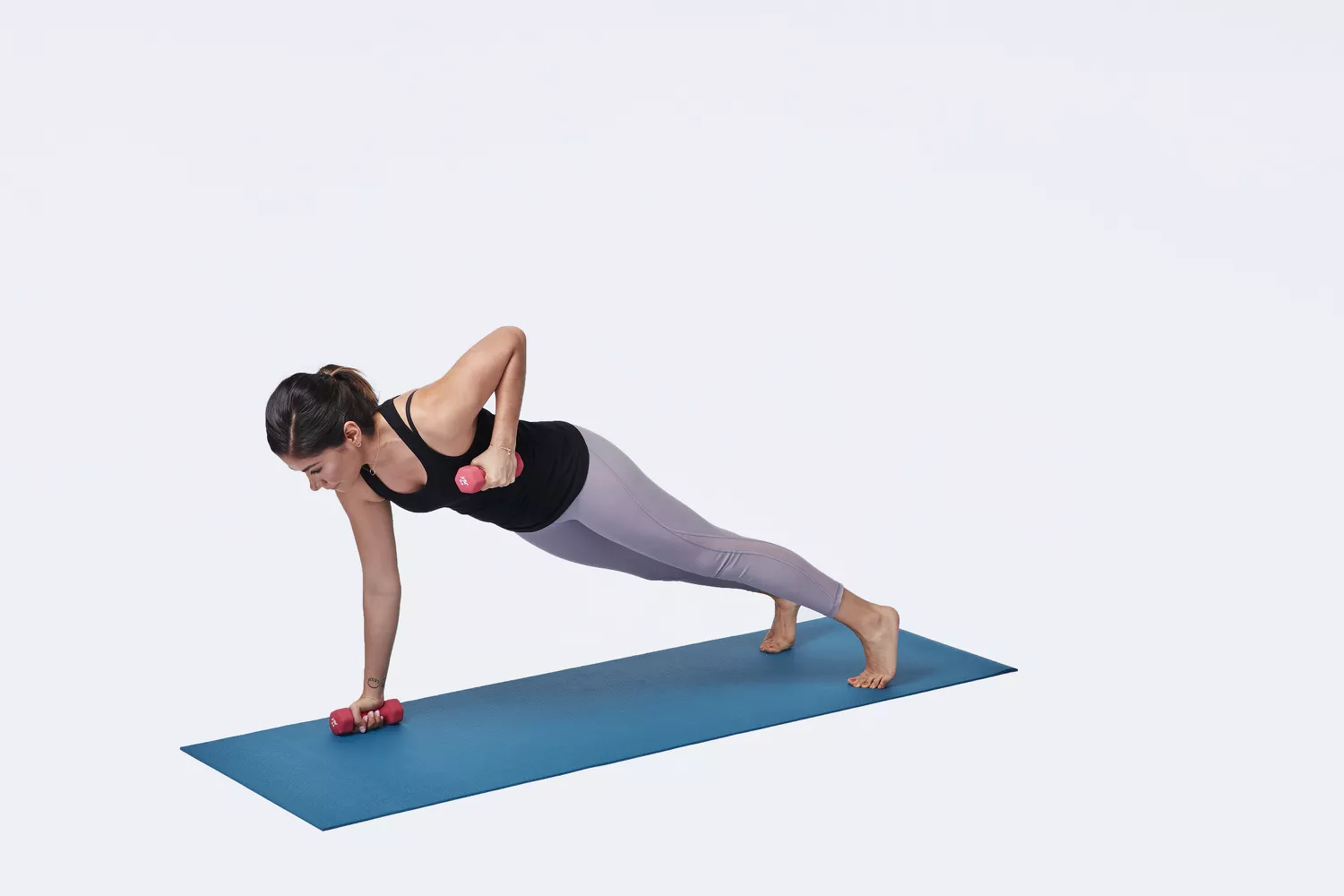
Verywell / Ben Goldstein
Perform a standard push-up with one hand on top of a medicine ball. This works the shoulder in a slightly different range of motion, which increases shoulder stability. You can also do an alternating medicine-ball push-up by rolling the medicine ball between each hand after a rep, which can help improve your balance.
It is easy to start making errors with push-ups if you are fatiguing or if you haven't built enough core strength. Look for these issues and switch to an easier variation if you can't maintain the best form.
One of the most common mistakes is sagging in the middle, caused by not properly bracing the core or keeping the torso stiff throughout the movement. You can practice with a modified plank exercise to build your core strength. Once you master that, try doing a push-up on your knees, practicing keeping your torso stable.
Your neck should be in neutral alignment, the head in a straight line with the spine, eyes to the floor, and the top of your head pointed away from your feet. If you point your chin up or drop your head so much that you can see your toes, you are out of alignment.
Locking your elbows at the top of the movement is a mistake you might make as you fatigue and want a little rest. But this places too much stress on the joints and can lead to strain or injury. Always keep a slight bend in the elbows. If you are fatigued, it's time to take a rest before doing another set.
If your hands are farther out from your body than your shoulders you are placing more strain on your shoulders. While you can vary how close your hands are together to get different effects, they should still be under your shoulders.
If you are only going down partially with most of your push-ups, you aren't getting the full benefit. It is better to switch to an easier modification (such as knee or incline push-ups) that you can do with the full range of motion.
You should not do push-ups if you have a shoulder, wrist, or elbow injury. Talk to your doctor or physical therapist to see if this is an appropriate exercise for your specific condition.
If you want to protect your wrists, you can place your hands on dumbbells or push-up bars to keep them in a neutral position. If you feel shoulder pain during the push-up or hear a clicking noise in your shoulder, end the exercise.
Repeat for as many repetitions as your workout routine requires. If you have to pass a fitness test, you can use a few simple strategies to build your strength and endurance in order to do more push-ups.
A popular push-up strategy is the "one more push-up a day" approach. This is when on day one you do one push-up, then on day two you do two push-ups, and so on.
Done properly, the push-up is a compound exercise that uses muscles in the chest, shoulders, triceps, back, abs, and even the legs.
If performed for one minute, push-ups can burn around seven calories, according to the Centers for Disease Control and Prevention (CDC) and the American College of Sports Medicine (ACSM).
The number of push-ups you should do each day will vary based on your current level of fitness and other factors such as age, sex, and weight. Fitness trainers advise performing push-ups in three sets. To figure out how many reps you should do per set, perform as many push-ups as you can in two minutes and then divide that number by three.
While some people try to perform as many push-ups as they can within a certain time frame until they tire out, this is not a recommended strategy for daily exercise as it could lead to burnout or injury.
Incorporate this move into one of these popular workouts:

The free Walk The Distance app is based on the Virtual Walk app and is available for both iOS and Android. It tracks your walking via the acceleromete

Also Known As: Front squat, barbell squat Targets: Quadriceps, glutes, hamstrings, and hips Equipment Needed: Barbell Level: Advanced The barbell fron

You may wonder where to start if you're new to exercising or if it's been a while since you last worked out. Your first step is learning how to create

Targets: Quadriceps Equipment Needed: Leg extension machine Level: Beginner Leg extensions should be a part of your workout regimen as they are one of

Wearing a rash guard while you enjoy the outdoors can help keep you safe from the sun’s harmful ultraviolet (UV) rays. The best rash guards are comfor

Dietary fiber is crucial for optimal digestive health, but its benefits extend beyond the gut. Adequate fiber intake can reduce the risk of heart dise
We are an information hub dedicated to delivering clear, trustworthy, and engaging content across a wide spectrum of topics — from innovation and trends to daily life, wellness, and global developments.
Our team is passionate about creating content that helps people stay curious, make informed decisions, and understand the world with greater clarity and context.
With a focus on quality, relevance, and accessibility, we aim to offer a meaningful experience for everyone seeking knowledge, ideas, and thoughtful perspectives.