
Motivate Yourself to Walk More With the Walk the Distance App
The free Walk The Distance app is based on the Virtual Walk app and is available for both iOS and Android. It tracks your walking via the acceleromete
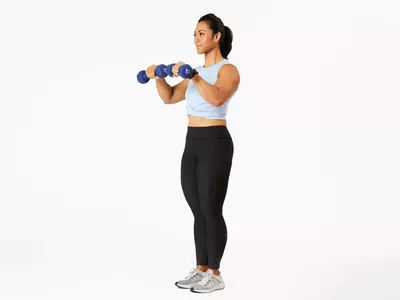
Also Known As: Reverse arm curl, reverse biceps curl
Targets: Biceps and forearms
Equipment Needed: Barbell, dumbbells, or EZ curl bar
Level: Intermediate
The reverse biceps curl is a variation of the standard biceps curl except, instead of gripping the weight with the palms up, your palms are facing down. Adding this exercise to your workout routine can help build stronger, more toned arms.
Verywell / Ben Goldstein
Stand up with your back straight, shoulders back, and chest lifted. Grip a set of dumbbells with your palms facing down (pronated grip) and rest the weights on the front of your thighs.
The upper arms remain relatively stationary during reverse curls.
The primary muscles targeted during the reverse curl are the biceps brachii and brachialis. The brachialis is not a readily visible muscle, as it’s hidden under the biceps. It provides a structural bridge between the upper arm bone and forearm and is the prime mover during elbow flexion.
Adding reverse curls to your workout can increase your ability to lift heavier weights during standard biceps curls and correct muscle imbalance between flexor and extensor muscles. Using a pronated grip promotes greater muscle activation than other grip options.
The reverse biceps curl is sometimes used during the rehabilitation of biceps injuries, though not until roughly three months post-injury. In everyday life, reverse curls can make activities like picking up a vacuum easier to manage.
The reverse biceps curl can be performed in a variety of ways to accommodate your fitness level and lifting preference.
If you have trouble maintaining good form, stand against a wall to perform reverse curls. This simple change-up will help you get the most from this exercise and allow for more effective lifts.
Perform reverse curls using an EZ curl bar for wrist comfort. This variation works to activate biceps muscles, allowing you to develop strength and exercise confidence.
If you don't feel comfortable using dumbbells, give a barbell a try. The steps and movements are the same. Using a barbell to do your reverse biceps curls works the same muscle groups, providing the same benefits.
You can also perform reverse curls using a cable station with a bar attachment. Attach the bar to the lowest pulley and you’re ready to go. (Don't forget to use a pronated grip with your palms facing down.)
Try a prone incline reverse curl for a challenging angle. Lie face down on an incline bench and do reverse curls in this position. This can be performed with a barbell, EZ curl bar, or dumbbells.
The use of a preacher chair offers support and challenges the peak contraction of the biceps and brachialis muscles. Place the back of your upper arms against the bench and extend your lower arms. Hold a barbell with a pronated grip and pull it toward the shoulders before lowering it down again.
If your wrists feel uncomfortable, try this exercise using an EZ curl bar and find the angle that works best for you.
The following are common mistakes to avoid performing reverse curls.
The standard biceps curl may allow for heavy lifts, but this is not the case for reverse curls. The goal is not to blast the biceps but to develop the hidden muscle under the biceps.
Using too much weight increases the risk of muscle and wrist injury. This is easily corrected by reducing the resistance to the appropriate level.
The quality of contraction always trumps the amount of weight being lifted. Consider reverse bicep curls a bonus exercise to enhance those heavier lifts.
Performing reverse curls requires your upper arms to remain stationary as you bend at the elbows to lift the dumbbells. Your hips and lower back should also remain stable.
Using momentum is a big indicator that the weight is too heavy. It places you at risk for potential shoulder and lower back injury. Be aware of proper weight resistance and body mechanics during your reverse curls.
It may feel natural to extend your wrists during elbow flexion, but doing so causes unnecessary stress on the wrist joint and extensor muscles. Maintain straight wrists throughout the full range of motion for effective and proper execution of reverse curls.
If you have an injury to your biceps, elbow, or wrist, you may want to avoid reverse curls. Alternatively, you can ask your doctor or physical therapist whether the reverse curl is safe given your specific condition.
If you experience pain or discomfort that doesn’t feel right during reverse curls, discontinue the movement. Start with a weight you can lift 8 to 12 times with proper form. Work up to two to three sets of 8 to 12 reps.
If you are new to reverse curls or weight training, it may be a good idea to enlist the guidance of a qualified personal trainer to learn proper form and decide how many sets and reps are right for you.
Incorporate reverse curls into one of these popular workouts:

The free Walk The Distance app is based on the Virtual Walk app and is available for both iOS and Android. It tracks your walking via the acceleromete

Targets: Quadriceps Equipment Needed: Leg extension machine Level: Beginner Leg extensions should be a part of your workout regimen as they are one of

Plus-size sports bras offer the support, coverage, and comfort needed to move with confidence—whether you're flowing through yoga or powering through

Amazon makes it easy to discover new legging styles inspired by your favorite activewear brands. These pairs are often less expensive than fan favorit

Well known for its comfortable and stylish activewear, lululemon has created a loyal community of fans for its functional, fashionable products—from s

It wasn't too far in the distant past when the options for athleticwear were fairly limited — cotton t-shirts, mesh athletic shorts, and heavy sweats
We are an information hub dedicated to delivering clear, trustworthy, and engaging content across a wide spectrum of topics — from innovation and trends to daily life, wellness, and global developments.
Our team is passionate about creating content that helps people stay curious, make informed decisions, and understand the world with greater clarity and context.
With a focus on quality, relevance, and accessibility, we aim to offer a meaningful experience for everyone seeking knowledge, ideas, and thoughtful perspectives.